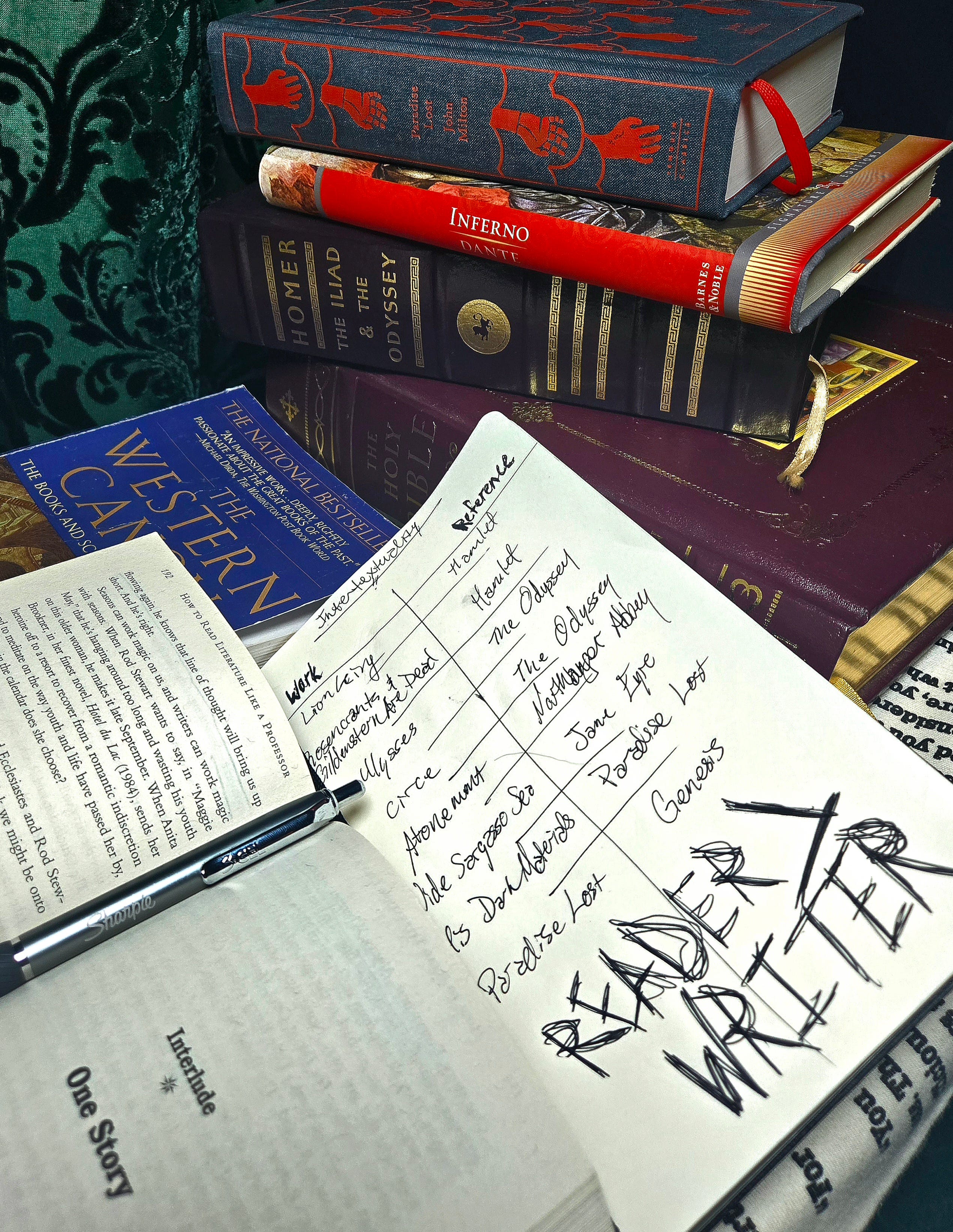
Intertextuality: The Relationship Between Books
Bitching About Star Wars, James Joyce, and ACOTAR

Elli vs. Star Wars
“It’s not canon!” I shout, dismissing the hard work of the authors who had the impossible task of retconning George Lucas. I scoff at the Star Wars book series, even as my husband swears these books answer all of the movie plot holes. I largely discredit this argument because I want to. And because the canon has always been imaginary. I’ll use the canon as a sword and a shield in these circular arguments.
I know there’s no possible victory, but I can’t just let my husband win an argument that I started. So I double down; it’s only canon if this or that, dependent on form or genre, the success of the story. This rejects the love of the fans and the reader’s reaction. All of that I could suffer, as I am used to being insufferable. However, the truth permeates the thick fog of stubbornness I’ve shrouded my mind in.
Like a true Jedi, my husband knows that everything is connected. The genre or format do not negate the human experience. Readers of books and watchers of movies all experience Star Wars. It’s one universe in which these stories engage. Call it a ripple effect. The influence of one story will teach and inform the next story that comes. Even in a universe far far away, we do not exist in a vacuum.
Intertextuality 101
This is the word I’ve been looking for! How did I acquire two degrees in books and never hear the word “intertextuality” before? Oh yeah… the drugs… Anyways… First, let’s define some common terms here so we can share a vocabulary.
Intertextuality: The relationship between texts.1
Plagiarism: To steal, copy without credit, and assume ownership of another person’s original work.2
Fair Use: Legal doctrine regarding the scenarios in which original work can be used without explicit permissions from the work’s creator/owner.3
Thomas C. Foster encourages his students to internalize the idea of “there’s only one story.”4 Writers become writers because they were readers. A writer is an observer and translator for the world around them. We’re all telling the same story because we’re all capturing what it means to be human in this world. Even Science Fiction writers inventing their own languages participate in intertextuality, as even to deny influence is to acknowledge it. A pessimist would view intertextuality as there being no wholly original thought. That’s true, but stunted in view. We build on the past to create the future.
The conflict of plagiarism and fair use is largely an issue for writers, not readers. Who copied who? Who gets the credit? WHO GETS PAID?! These are the concerns of the creator, having born their work into this world. Readers however, can consume wholly plagiarized content without even knowing the conflict they participate in. Students aren’t aware of the fair use their teacher’s engage in, yet their education benefits.
Fair use and plagiarism are a direct assumption of a quantifiable work. Whereas intertextuality explores how we learn from an example and reapply the principles to serve our own end. A writer is not copying and pasting Shakespeare if they allude to Romeo and Juliet’s balcony scene. When a writer does this successfully we notice the shared themes between the two texts. We can see the parallels between the stories, and possibly even resolve new conflicts with past reasoning. Upholding intertextual standards allows us to clearly delineate where Fair Use laws can engage. We cannot merely copy the structure, verbiage, and plots without implicating plagiarism. But the intertextual writer doesn’t need to plagiarize! They can intake any work, learn from it, and build something unique from that foundation.
Nothing is Original
Calm down Nietzsche. I get it, we live in future and the wheel has already been invented. Boo-hoo you baby. Check your ego and carry on. You cannot let the anxiety of influence stop you from creating, so says Harold Bloom. That anxiety should push you to create better work, not cheap derivatives.5 But that anxiety does stop some creators, where it should inspire them to dig deeper into the canon and into their craft.
I rage against ACOTAR for being an obvious derivative of Disney’s Beauty & The Beast. But you won’t catch me talking shit about James Joyce.6 Why? Joyce has cemented his place in the canon through his mastery of intertextual story telling, whereas Maas is focused on cementing her place in the hearts and minds of the BookTok community. As a publisher, I love a bandwagon full of consumers ready to purchase everything in the franchise. As a literary critic, I rally on the side of aesthetics and intertextuality.
“In intertextual theory, the reader took the place of the author that was previously considered the source and owner of meaning”7
The mindset of the reader is paramount in intertextuality. If you’ve never read Homer or if you didn’t know anything about The Odyssey, you won’t understand Joyce’s success in Ulysses. The reader is the connection point between the two texts. Maas may have taken pains to distance Feyre from Belle, but the success of her attempt lies in the reader’s reception. For me, Maas is unsuccessful. I can’t unread the Beauty & The Beast of it all. The overall impression I’m left with is a derivative work pandering to YA audiences, assuming they cannot make these simple connections and will be more focused on the romance than on the rhetoric.
I’m not the average reader. I too hear “PICK ME! PICK ME!” but whatever. I have two degrees in literature and work in academic publishing. I am blatantly bias. I want the best of the best and I think audiences deserve that too. I tell all ACOTAR fans, I truly hope the live action adaptations are successful. Soft core Netflix porn is always on in the background of my house. I appreciate a cheap cult classic, but come to me with some badly written fairy smut? I’m not joining your book club.
Unless I’m the literary agent, in that case let’s go bigger! I’ll get you Times Square for your half naked bat boys.