Masterclass Review: Margaret Atwood
Learning Creative Writing, OR, Learning from Creative Writing

Learning from Professor Atwood
What would you do to learn writing from Margaret Atwood? I made my husband buy me Masterclass, which costs roughly $100/year. That’s still cheaper than being a student at the University of Toronto and/or York University, where Atwood teaches creative writing! With over 40 titles to her name, students must be competing for a space in her classes.
I was once a naive English student signing up for random courses with no idea who would be the teacher, concerned only with time slots and schedules. What a luxury - to choose to learn under a contemporary master! At 19 I hadn’t read The Hand Maid’s Tale or Alias Grace, had I been given the privilege it probably would have been lost on me. I was only focused on critique of literature, not the process the authors go through to create the literature itself. Now, with a more open mind, I am deeply grateful for the access to her Masterclass.
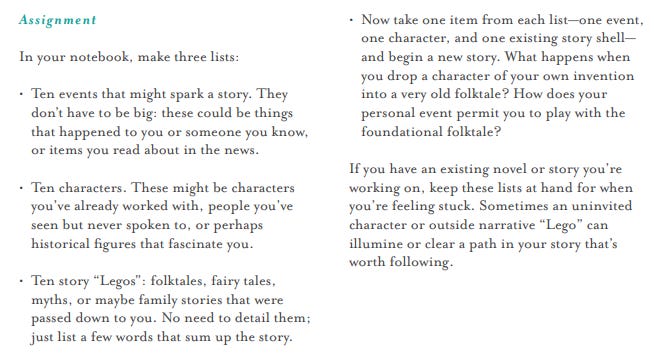
This is one of the longest and most in-depth courses I’ve taken to date, and felt very much like an undergraduate level course distilled into major learning outcomes. Coming from a formal educator, this Masterclass was organized and robust. Atwood provided a true primer for learning the basics of creative writing - the Table of Contents feels like a 12-week syllabus. In this course she examines case studies using her own works, also providing examples from her own education or teaching. But the best part? She also assigns writing exercises as “homework” in the downloadable 92-page Class Guide. Now I can listen to the lecture, do the assignment, and fall asleep to nightmares of showing up to the test naked.
Learning from Myth
This Masterclass focuses on Atwood’s own brand of speculative fiction, her use of myth, and her values for storytelling. As you can see from the Assignment above, Atwood pushes her students and her readers to consider the foundational stories that are woven into our cultural consciousness.
Perhaps you remember another beloved Professor, C.S. Foster who teaches the importance of intertextuality to his students. He wants his students, readers or writers, to understand the building blocks of the “One Story” we are all telling. If the Brother’s Grimm use an archetype or symbol, be aware of it. Look to Shakespeare, The Bible - myth, religion, fairy tale. These inform the foundation that all new stories are built upon.
Atwood also wants her students and readers to consider the “Lego” blocks she has used in her work. A writer couldn’t create something like The Handmaid’s Tale without borrowing and building on the Christian religious texts and Abrahamic stories. Some of the essential Christian stories Atwood recommends are:
Creation
Cain and Abel
The Flood
The Exodus from Egypt
Joseph and his Brethren and the aftermath
Samson and Delilah
The Book of Job
David and Bathsheba
Solomon and the Queen of Sheba
The Babylonian Captivity
Jonah and the Whale
Learning from Scheherazade
Atwood is truly an educator, because this course gave me the vocabulary I was missing to understand what I’ve already been doing and observing. She has giving some structure and form to the tools I have discovered intuitively. In order to transact upon any potential, I need the ability to articulate my intentions. Now I feel like a door has opened between reading and writing - this is what I was looking for!
As Atwood described the structure of One Thousand and One Nights, I felt like I was back in undergrad, listening to a master at work. It’s simple and easy to miss - start with structure. The story of Scheherazade is the story of a master using structure to their advantage. The structure is a frame story, telling one tale with multiple stories inside it. The Canterbury Tales or The Princess Bride were the frame stories I was familiar with, but I appreciate the example of One Thousand and One Nights as it pairs the structure of a frame story with the importance of pushing toward the conclusion. It builds tension and diversity. Noticing and critically analyzing the structure of a story helps me read it closer. I will be adding to my TBR, Peter Brook’s Reading for Plot, recommended from this section of the course.
After structure, I also particularly enjoyed the lessons on character building. Stories are events AND characters, not one or the other! Without the threat of Scheharazade’s impending death she would not have been put in the position to tell her Sultan stories over one thousand nights. She expands in this space to rise to the occasion and break the cycle of events. Her character is developed by the events, the structure of the story gives her the space to evolve as the plot progresses.
Interesting people in interesting conflicts - that’s the story you want! Action reveals the intention and beliefs of characters, as it did with Scheherazade. The best writers are SHOWing a character’s beliefs, not relying on TELLing audiences what they believe. Atwood recommends plotting a characters life on a timeline against pop culture, history, and political events. Track the influences at the macro and micro level that would build a whole, complex personality for your character.
Some of my favorite character building questions that Atwood poses are:
Do they dress in a way that is age-appropriate? Or do they dress to look younger or older?
Did they have a bad childhood? Or a good childhood suddenly ruined by tragedy?
Do they have any pets?
What are their friends like?
What do they do in their spare time? Do they have spare time?
Learning, Myself
I will have to spend some time working through the exercises and assignments from this Masterclass, as I’m really excited to try these out. I love reading and will never stop, but I want to try more writing exercises that will help me appreciate the masterpieces contemporaries like Atwood are producing. Perhaps I’ll share them here, inspired by Atwood!
Stop looking for permission to begin. No one can teach you what you want to create. You must develop discipline to pull your creations into fruition. And this course was a step in that development, giving me the vocabulary I need to articulate my attempts. For so long I’ve spent my time the reader, the publisher. What will it feel like to dip a toe into the waters of creation?
“You become a writer by writing.” - Margaret Atwood